
Amazon no longer wants to watch the in-flight Wi-Fi market from the tarmac. The company has just signed a multi-year agreement with Delta Air Lines to deploy Amazon Leo , its low-Earth orbit satellite network, on 500 aircraft starting in 2028 .
The promise is ambitious: to offer a high-speed, low-latency, door-to-door connection, while maintaining free access for SkyMiles members, in line with Delta’s current strategy.
This partnership marks a turning point for Amazon. Until now, the company had mostly been operating behind the scenes with its former Project Kuiper, renamed Amazon Leo. Now, it is directly tackling one of the most visible areas of consumer satellite connectivity: in-flight internet, a space where Starlink has already gained a significant lead with several airlines.
Finally, in-flight Wi-Fi that no longer feels like a compromise.
Anyone who has ever tried to work, watch a video, or simply send files on a plane knows the limitations of current systems. Even when available, they often remain unstable, slow, or too inconsistent to truly convert flight time into productive time.
This is precisely what Amazon and Delta are trying to address. By using satellites in low Earth orbit, much closer to the planet than traditional geostationary systems, Amazon Leo promises reduced latency and significantly higher speeds. Delta even mentions performance that could be three to five times faster than existing systems, while some sources report theoretical speeds of up to 1 Gbps in certain scenarios .
On paper, this changes everything. Seamless streaming, instant presentation sending, sharing videos or photos without waiting for landing: in-flight Wi-Fi ceases to be a supplementary service and becomes a credible extension of connectivity on the ground. This interpretation is analytical, but it is based on the capabilities highlighted by Delta and Amazon.
Delta isn’t just signing up for Wi-Fi, but for a broader Amazon ecosystem.
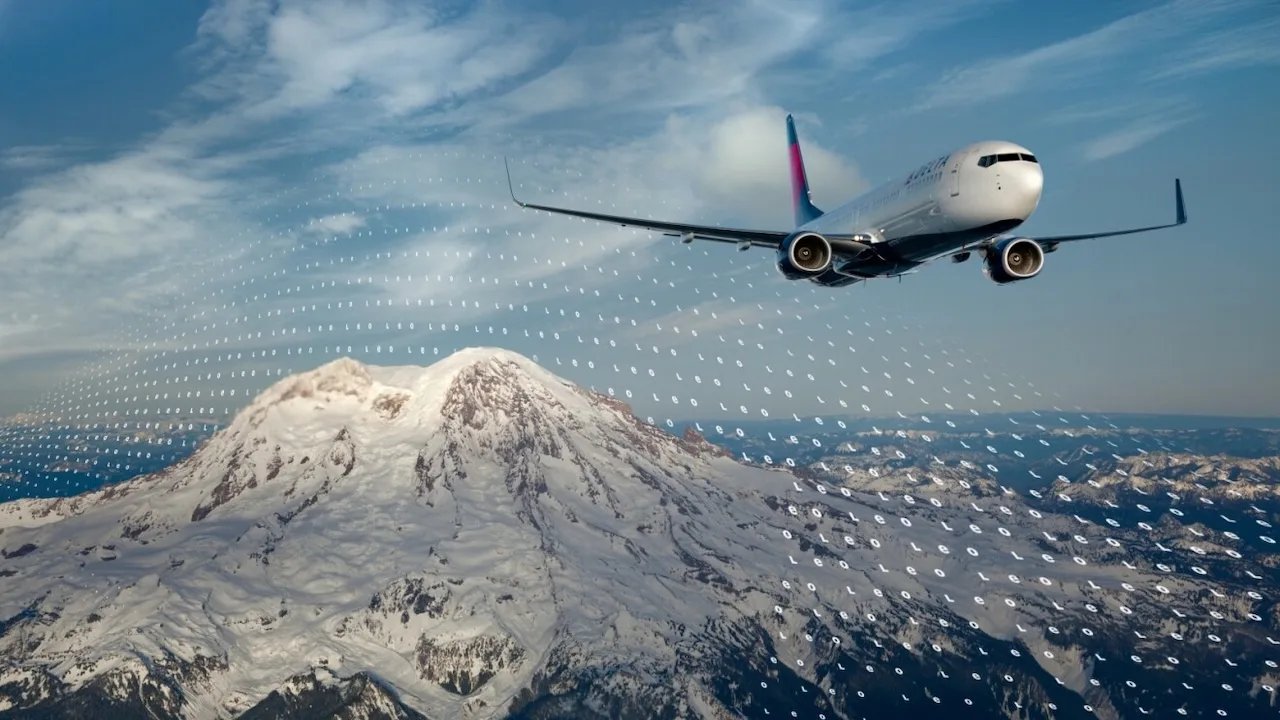
The agreement goes beyond simple internet access. The existing relationship between Delta and Amazon Web Services influenced the decision, and the Wall Street Journal adds that the two groups are already looking further ahead, with the idea of integrating more Amazon tools into the travel experience, including AI layers and onboard digital services.
In other words, Delta isn’t just choosing a bandwidth provider. The company is strengthening a strategic link with Amazon across multiple layers of its digital infrastructure. This is what makes this partnership particularly interesting: it combines satellite connectivity, cloud computing, and potentially smart services in a single operation.
Faced with Starlink, Amazon is finally going on the offensive
The other interpretation, impossible to ignore, is obviously competitive. Starlink already has a massive advantage in terms of the number of satellites deployed and agreements signed with several airlines, including United, Alaska, and Southwest, according to the Wall Street Journal. Amazon Leo, for its part, has already signed JetBlue and is now adding Delta, making it its most visible move in aviation to date.
The battle that is unfolding is not only technological. It is also symbolic. Starlink has long held a monopoly on the image of a useful, fast, and immediately monetizable satellite. With Delta, Amazon is demonstrating its desire to be a part of passengers’ real lives, not just something on industrial roadmaps . And in the airline industry, this visibility is crucial.
An ambitious gamble, but still focused on 2028
However, one important caveat must be kept in mind: none of this will happen tomorrow morning. Deployment on the first 500 devices is planned to begin in 2028, which leaves plenty of time before the promise can be judged in real-world use. Until then, Amazon must continue to expand its constellation. The company has already launched 214 satellites since April 2025, plans more than 20 additional launches in the coming year, and has already reserved around 100 future launches with several operators, including Blue Origin , ULA, and even SpaceX.
This timeline also tells a story: Amazon isn’t entering this market halfway. The company knows it’s up against a well-established player, and it’s trying to compensate for its initial lag with strategically important agreements with major transportation brands.
What this changes for passengers
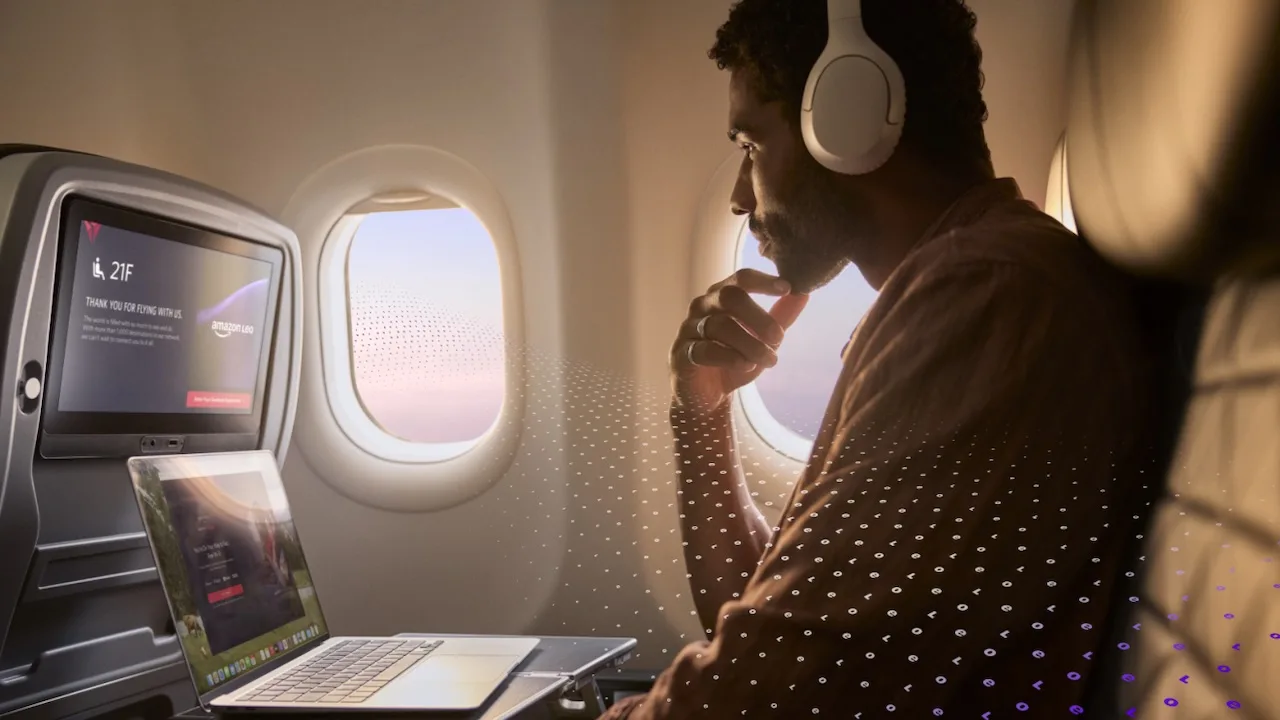
For the traveler, the promise is ultimately very simple: a flight where internet access no longer feels like a frustrating compromise. If Amazon Leo keeps its promises, Delta could become one of the airlines where connectivity ceases to be a tolerated inconvenience and becomes a truly differentiating service. And in an industry where the premium experience increasingly hinges on digital details, that’s no small detail at all.
Ultimately, this partnership reveals something broader. In-flight Wi-Fi is no longer just a convenience. It’s becoming a battleground for tech giants, with SpaceX and Starlink on one side, and Amazon and Leo on the other. For passengers, this is probably the best possible news: when two titans compete to make the connection usable at 10,000 meters, there’s finally a chance that internet access on airplanes will cease to be the weak link in the travel experience.